

ARTIFICIAL INTELLIGENCE · ~15 MIN READ
5 big ideas
shaping the search for AGI
There is no single path — or official taxonomy — for AGI. This article organizes several influential lines of thought into five broad approaches that overlap and complement one another, with an interactive demo of each.
CHAPTER 01
What is AGI, anyway?
There is no consensus definition of artificial general intelligence (AGI). One useful formulation is a system able to learn, reason, adapt and transfer knowledge across a wide variety of tasks and environments, with generality comparable to humans.
Multimodal foundation models already write, analyze images, program and use tools. The frontier is therefore not simply “one AI per task”: it also involves out-of-distribution generalization, continual learning, autonomy, deep adaptation and reliability in unfamiliar situations.
To explore the problem without pretending there is a canonical classification, we group five influential lines here. They are not exclusive boxes: embodied AI can be connectionist, universalist architectures can use neural components, and most modern projects combine more than one line.
CHAPTER 02 · APPROACH 01
Symbolic: intelligence is logic
AI's oldest bet: representing knowledge explicitly with symbols and relations. “IF → THEN” rules are an entry point, but the family also includes formal logic, knowledge graphs, ontologies, planning, search, constraint satisfaction and mathematical solvers.
Works like a methodical detective. Answer the questions below about the animal on the card and watch the rule trigger:



IF it has feathers AND it has wings THEN it is a bird
ANSWER THE FACTS FOR THE ENGINE TO REASON
THE POWER OF CHAINING — conclusions become facts for the next rule:
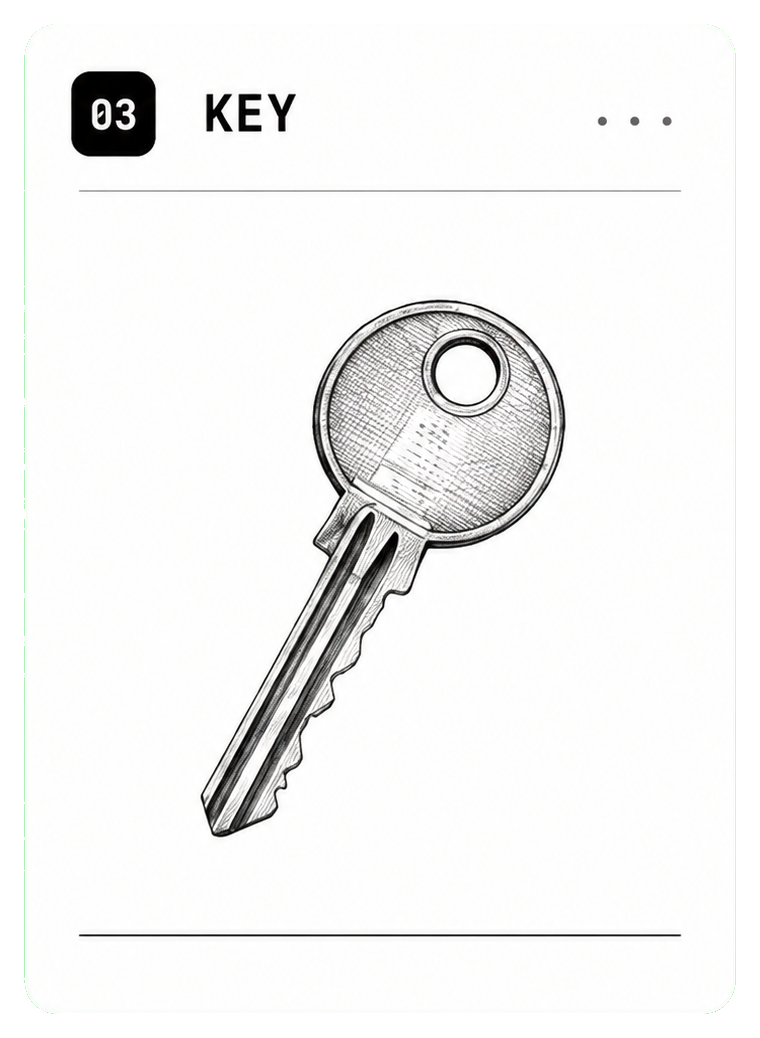
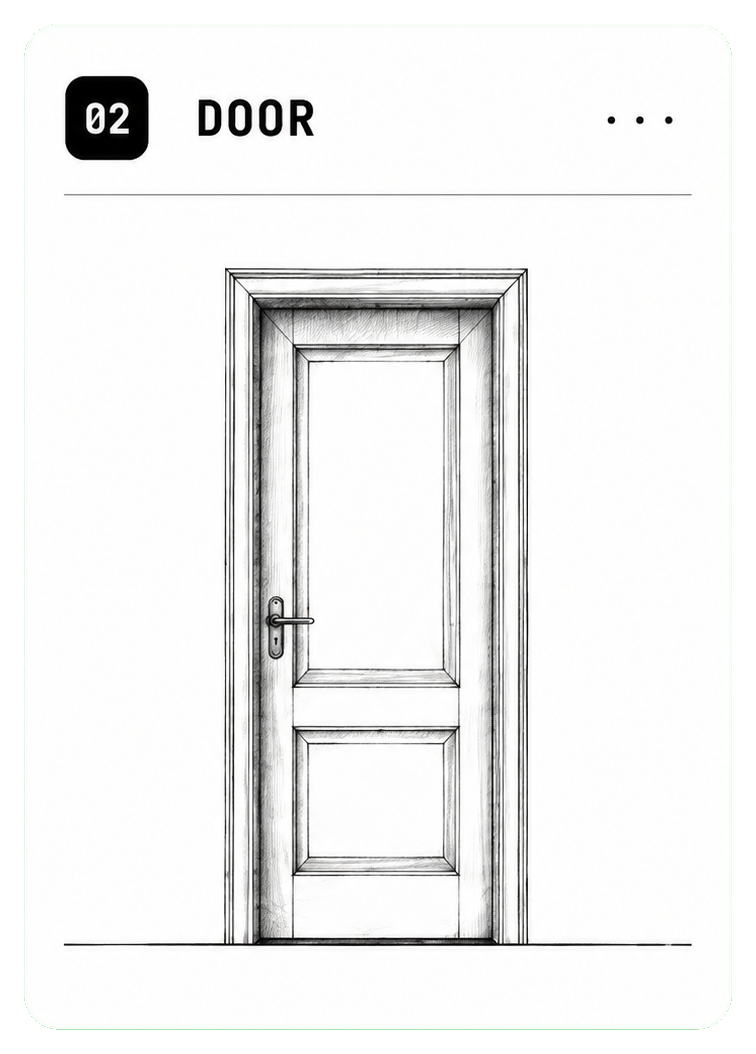
Strength: conclusions can, in principle, be traced through the rules and facts used. This helps with planning, verification and auditing. Limit: systems with millions of rules, conflicts and deep searches can also become hard to analyze; the real world is too ambiguous to anticipate entirely by hand.
CHAPTER 03 · APPROACH 02
Connectionist: intelligence emerges from data
The opposite bet: instead of writing rules, build a neural network and show it thousands of examples. Intelligence is not programmed — it emerges from the parameters that are adjusted during training. It's the approach behind virtually all modern AI, from image classifiers to large language models.
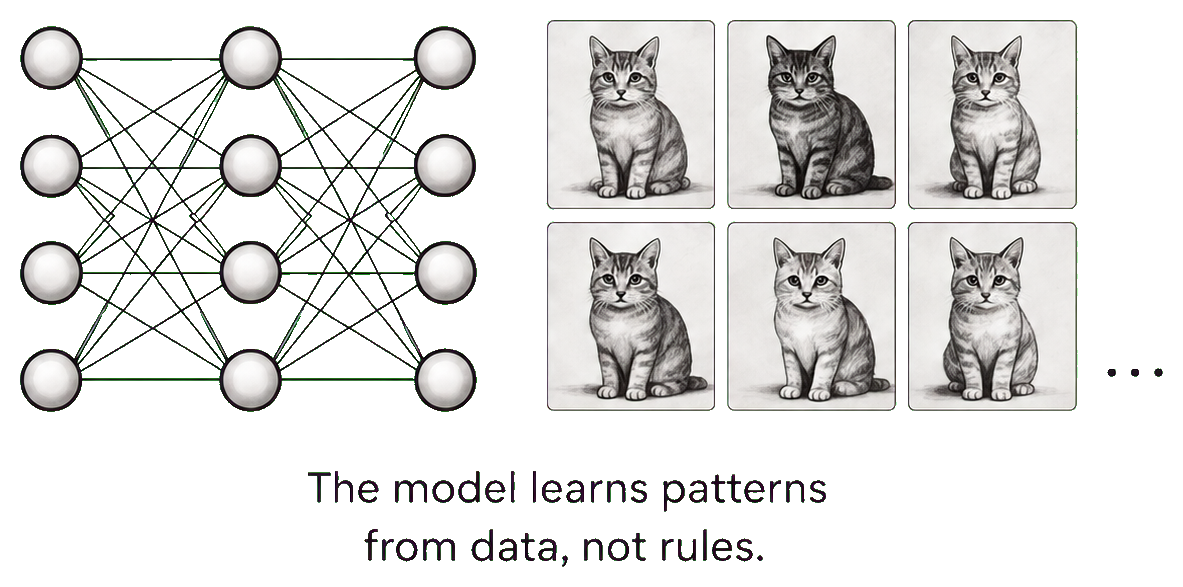
"I ONLY LEARNED THAT THE TRAINING PHOTOS LOOKED SIMILAR. I DID NOT LEARN WHAT MAKES A CAT A CAT."
Notice the contrast: no one wrote a rule about cats — the model learned patterns from data. Neural systems can also display behavior that resembles reasoning, planning and composition; the open question is how robustly those abilities generalize. Interpretability methods can probe representations and attribute importance, but they still do not provide a simple, complete causal trail.
A network may produce a natural-language justification, but that justification does not necessarily reveal the internal process that generated its decision.
CHAPTER 04 · APPROACH 03
Universalist: intelligence is mathematics
What if a general agent could be defined mathematically? A central formulation in this line is AIXI, proposed by Marcus Hutter. It combines Solomonoff universal induction — a simplicity-weighted distribution over computable environments consistent with the history — with sequential decision-making to choose actions that maximize expected reward.
AIXI · IDEAL UNIVERSAL AGENT
HISTORY → COMPUTABLE ENVIRONMENTS → PREDICTION → ACTION
ξ = Σq: U(q,a)=e 2−ℓ(q)
"consistent hypotheses are weighted by simplicity; actions maximize expected reward"
The expression captures the intuition behind the universal mixture: consider programs that could explain the history and assign more weight to shorter ones. The demo below simplifies the conceptual cycle — it is not an implementation of AIXI:
THE SAME CYCLE SOLVES COMPLETELY DIFFERENT PROBLEMS
Strength: it provides a formal reference for agents that learn and decide in unknown environments. Limitation: ideal AIXI is uncomputable because it depends on universal induction and a search over computable possibilities; bounded approximations remain extremely expensive. It is a theoretical compass, not a ready blueprint.
CHAPTER 05 · APPROACH 04
Embodied: intelligence needs a body
This approach makes a provocation: brains didn't evolve to think — they evolved to control bodies. Intelligence would emerge when a system has sensors, actuators and real consequences: it acts in the physical world, feels the result and forms concepts from experience, not from descriptions.

Datasets can record weight, force, texture and dynamics, but passive observation is not equivalent to interactive, causal experience. Strength: perception, action and consequences ground concepts in the world. Limitation: collecting physical experience is slow, costly and risky, so the field combines simulation, imitation, teleoperation, synthetic data, world models and sim-to-real transfer.
CHAPTER 06 · APPROACH 05
Hybrid: the best of both worlds
Hybrid systems — including neurosymbolic families — attempt to integrate data-driven learning, explicit knowledge and reasoning. This is not a fifth isolated box; it is a composition strategy that can incorporate elements from the other lines.
The demo uses a deliberately incomplete scenario: imagine that the network has never seen a penguin and that the symbolic knowledge base contains only the naive rule “birds fly.” Compare how the components can fail alone and correct one another when combined:
CLASSIFY TO SEE HOW EACH MODE BEHAVES
In this hypothetical setup, the network fails out of distribution and the symbolic base fails because its knowledge is incomplete. A well-trained network or a better rule could succeed alone. The value of the hybrid is that perception and structured knowledge can constrain, verify or correct one another. Integrating them, however, remains complex and has no single recipe.
CHAPTER 07 · THE BIG PICTURE
The complete picture
None of these lines has solved general intelligence. Many researchers consider it likely that more general systems will combine multiple capabilities, but there is no consensus about which components are necessary — or whether the five lenses in this article are sufficient.
- PERCEPTIONNeural networks reading the messy world: images, sounds, language.
- REASONINGSymbolic structures for logic, planning and explanation.
- THEORETICAL FOUNDATIONUniversal principles telling you what to optimize and why.
- PHYSICAL EXPERIENCEBody, sensors and consequences anchoring concepts in reality.
- MEMORY & CONTINUOUS LEARNINGAccumulate and transfer knowledge between domains, without forgetting.
- USE OF TOOLSContinuously interact with the world — and with other systems.
The objective is not merely to produce answers. It is to learn, act, revise strategies and remain capable as conditions change. Combining capabilities is a strong hypothesis — not settled scientific consensus.
CHAPTER 08 · BEYOND THE FIVE LENSES
Pieces that span every approach
Some capabilities do not belong to a single school. They cut across neural, symbolic, embodied and hybrid architectures — and may matter as much as the choice of paradigm:
- WORLD MODELSPredict consequences, simulate possibilities and plan before acting.
- CONTINUAL MEMORYConsolidate experience, update knowledge and resist catastrophic forgetting.
- METACOGNITIONRecognize uncertainty, notice when it does not know and revise its strategy.
- AGENCY & TOOLSDecompose goals, run code, consult sources and verify results.
- GENERALIZATIONTransfer knowledge to situations truly outside the training distribution.
- COGNITIVE ARCHITECTURESSOAR, ACT-R and Global Workspace integrate memory, attention, goals and control.
- OPEN-ENDED LEARNINGEvolution, curiosity and task generation that continually expand the repertoire.
- SOCIAL INTELLIGENCECooperation, competition, language, imitation, culture and multi-agent systems.
- SAFETY & ALIGNMENTKeep goals controllable, handle values and prevent reward exploitation.
END · THANKS FOR READING
Want more interactive content?
There's an article on System Design in the same format — and a full-screen guided visual experience.